A PBM quote can look more attractive because the price is better. It can also look more attractive because the assumptions behind it are more favorable. A stronger evaluation separates the two.
The first two articles explored why similar-looking quotes can produce different results and why the stakes are higher. The next step is a consistent method for seeing what is actually being compared.
Start with independent data. Then translate every bid into a common language and normalize utilization before price enters the conversation.
No. 1: Start with independent data
For AWP-based offers, average wholesale price is the benchmark against which many discounts are measured. Independent pricing and drug-classification data provide a neutral starting point for checking those terms.
Relying only on the bidder’s file leaves the evaluator dependent on the bidder’s representation of that baseline. Use an independent source and consistent benchmark dates so the offers start from the same reference point. It is the same principle as using an independent appraisal rather than relying only on the seller’s estimate of value.
That step does not settle the rebate terms, exclusions or final cost. It makes the baseline behind the comparison easier to verify.
No. 2: Translate every bid into a common language
Independent data gives you a neutral starting point. Next, you need a common set of definitions.
PBMs may use the same labels (brand, generic, specialty, limited distribution) differently, and those differences can determine which pricing tier, guarantee, exclusion or contract term applies. A drug can be treated differently from one PBM to the next even when the percentages on the page look nearly identical.
Before comparing the economics, confirm what the definitions mean, which drugs fall under them and where those differences could change the result. Keep classification separate from formulary placement. One determines how the contract treats a drug for pricing or guarantees; the other helps explain coverage and preference. Both need review, but they are not the same check.
No. 3: Normalize utilization before price enters the conversation
Once the definitions are aligned, examine the assumptions behind utilization. Formulary placement, clinical criteria, prior authorization, step therapy, channel mix and program uptake can all change the projected result. Population, plan-design, trend and pipeline assumptions matter, too.
Start with practical questions. Which therapies are preferred? What documentation does approval require? How many members are expected to participate in a program? Are its projected effects modeled against this client’s actual utilization, or simply taken from a capability list?
Use a common comparison baseline to isolate price differences. Then show the modeled effects of each PBM’s actual formulary and clinical programs. Normalization should make those differences visible, not erase them. Otherwise, a richer rebate or deeper discount may be sitting on top of a different drug mix or a more favorable utilization scenario.
Normalize utilization first. Then compare price.
Keep the projection separate from the promise
The comparison shows an expected result. The contract determines which commitments the PBM is accountable for, how they are measured and what happens if they are missed.
Agreed definitions, program commitments, guarantees, exclusions and remedies need to be clear. Not every assumption in a model becomes a contractual promise. Keep the analysis available for monitoring and reconciliation so the next review starts with a record of what was expected and what was delivered.
Making that standard repeatable
Each of these checks is doable on its own. Applying all three consistently across thousands of drugs, multiple formularies and competing contracts, case after case, is harder.
LinQ gives brokerage teams a consistent way to bring independent pricing data, common definitions, clinical criteria and utilization assumptions into the same evaluation before the financial comparison is built.
The result is a clearer view of the economics behind each offer and a recommendation the team can explain with confidence.
Use the PBM Evaluation Checklist to put the method to work before the RFP, while reviewing offers and before the recommendation goes to the client.
Bring us an upcoming case. We will use LinQ to help surface the variables most likely to affect the comparison before your next PBM RFP goes to market.
A PBM comparison does more than rank discounts and rebates. It helps a client decide how to manage pharmacy cost, what changes members may experience and what to expect from the contract.
When the assumptions behind that comparison are unclear, the recommendation becomes harder to explain. When they are clear, the broker can show what is driving the expected result and where the trade-offs sit.
That distinction matters for three reasons: the dollars involved, the visibility expected and the responsibility to keep reviewing the decision after placement.
More spend is riding on the decision
Business Group on Health’s 2027 employer survey identifies pharmacy as a significant source of cost pressure, with GLP-1 use, complex therapies and chronic conditions among the contributors.
For a broker, the implication is to understand how the management strategy behind the quote affects the client’s expected spend. What it’s not is simply to negotiate a stronger discount.
A different preferred therapy, a change in program participation or a shift in where a drug is administered can change the projection. A headline guarantee may not make those differences visible.
This is where the first article’s distinction matters: better unit pricing and lower total spend are not automatically the same result. The comparison needs to show the effect of pricing alongside the effect of drug mix and utilization.
The larger the financial decision, the more important it is to know what is driving it.
More transparency is expected
Transparency begins with knowing what is being paid and to whom. For covered brokerage and consulting arrangements with ERISA group health plans, federal disclosure requirements already address expected direct and indirect compensation. The Department of Labor explains that the information generally must be provided reasonably in advance of entering into the arrangement.
Compensation disclosure is one part of the picture. It does not, by itself, establish that two PBM proposals are comparable or that one will produce a better economic result.
The analysis still needs to make its definitions, assumptions and exclusions visible. Which drugs fall under each guarantee? What utilization was assumed? Which program effects are included in the savings projection?
Getting to the number matters. Being able to explain it does too.
Fiduciary oversight continues after selection
Department of Labor guidance describes hiring a service provider as a fiduciary function and emphasizes documenting selection and monitoring processes. It also calls for periodic review of service-provider performance and fees.
For the broker supporting that work, a clear recommendation should leave a usable record of the analysis: the information considered, the assumptions applied, the trade-offs evaluated and the reasons for the recommendation.
That record also provides a starting point for reviewing performance. If results differ from the projection, the team needs to distinguish changes in utilization or drug mix from a missed contractual commitment.
A reprice is a projection. The contract determines what the PBM is accountable for.
Documenting the process does not guarantee a financial result or eliminate legal risk. It makes the reasoning available for review and helps identify what needs attention next.
The pressures converge on the same decision
Spend, transparency and oversight are not three separate reasons to build three different processes. They all point to the value of one clear evaluation.
The comparison should show why one strategy is expected to produce a better result, what changes that strategy asks members to make and which commitments can be tested after implementation.
That is more useful than treating defensibility as a separate exercise at the end. The same analysis that supports the recommendation should help the client understand the economics and give the team a basis for ongoing review.
In the final article, we turn that principle into three practical checks: establish an independent baseline, translate the definitions and normalize utilization before comparing price.
Put two PBM quotes side by side. The discount off average wholesale price is the same, the rebate guarantees are close and the administrative fees line up. There may not be much to separate them at first glance. But those headline terms can sit on top of very different pharmacy strategies.
Formulary choices, clinical criteria and utilization all help determine what a plan ultimately pays. Similar pricing does not necessarily mean similar total spend. The challenge is not that broker’s don’t have the expertise. It is making the variables behind the quote visible enough to evaluate them. That starts with understanding what unit price does, and does not, tell you.
Why unit price only tells part of the story
There’s a reason why the focus had been on discounts, rebate guarantees and fees. They matter and they’re easy to put in a column. But they do not tell you which drugs will be dispensed, how much will be used or which members will receive coverage.
Those are questions about utilization and drug mix. Formulary strategy and clinical criteria influence which treatments are preferred, when prior authorization is required and what information is needed for approval.
Two PBMs can offer similar headline pricing and still project different total spend because the mix and volume behind that pricing are different.
Pricing matters. Utilization matters. Neither tells the full story on its own.
Lower unit cost does not always mean lower total cost
You see this every time you shop in bulk. Buy more and the price per unit usually comes down. That can be a good deal, but only if the amount you are buying makes sense. A lower unit price on more volume can still leave you with a bigger total bill.
PBM pricing can work the same way. One PBM can show a better discount while its formulary and clinical criteria drive more utilization. Another can show a less aggressive discount but produce lower total spend.
That is why the discount is only part of the conversation. The next question is: What will actually be dispensed, and why?
When a better rebate can cost more
Consider the therapies used for plaque psoriasis. Skyrizi and Yusimry have approved uses in this condition, but they are different medicines with different clinical considerations. Yusimry is a biosimilar to Humira, not to Skyrizi. [1, 2][KD1]
The point is not that one can automatically replace the other. The appropriate treatment depends on the patient and clinical judgment. The economic question is how a PBM’s formulary and clinical strategy shape the mix of therapies the plan is likely to cover.
In an illustrative comparison, a higher-cost therapy may carry a larger rebate. If more utilization flows to that therapy, an attractive rebate guarantee can coexist with higher total plan spend. The rebate number alone does not establish which strategy is less expensive.
Before comparing the rebate, understand the treatment mix behind it and the clinical reasons for that mix.
The same drug can mean different utilization
GLP-1 coverage illustrates the other side of the problem: how many members qualify under a program’s actual criteria.
Different prior-authorization requirements, treatment-history documentation or approval processes can change projected utilization. A projection based on one set of criteria should not be treated as equivalent to a projection built on another.
That is not an argument for restricting appropriate care. It is a reason to understand the actual clinical program, its member impact and the assumptions used to model it before judging the price.
The price of a claim and the number of claims are different parts of the same calculation.
The management trade-off
A richer rebate or deeper discount can sit on top of higher utilization. The quoted deal can look better as management loosens while net plan spend moves the other way.
Management also affects members. Formulary changes may require some members to change therapies and clinical programs may add review or documentation at the point of care. The type, timing and extent of that impact matter alongside the expected economics.
The point is knowing what the client is trading and whether the economics justify it, not that more management is always better.
The market optimized for what buyers measured
When a comparison emphasizes the discount and rebate, it rewards what those lines show. Formulary strategy and clinical criteria are harder to compare, but that does not make them less important.
A rebate guarantee fits in a cell. A clinical protocol does not.
A stronger evaluation makes room for both. It separates pricing differences from differences in utilization, drug mix and assumptions, so the recommendation is based on more than the best-looking headline number.
I’ve met a lot of consultants who get confused by drug rebates. Are they good? Are they bad? I can tell most don’t fully grasp the subject when I’m asked: What is the rebate on XYZ drug? The misunderstandings associated with rebates leads to bad decision making and a cascade of errors: clients choosing the wrong PBM, paying excess costs, taking additional risks, implementing counterproductive “cost savings” programs – all the way up to poorly constructed state and federal legislation. In this piece, I’ll cover how drug rebates work, when they’re good, when they’re bad and some consulting guidelines to help you shepherd your clients into arrangements that are well suited for their needs.
Whataredrug rebates?
Drug rebates are complicated, but probably the simplest explanation of a drug rebate is: It is a payment made by a drug manufacturer to a pharmacy benefit manager in exchange for access to a market and additional services provided by the PBM. The most significant drug rebates are formulary rebates and market share rebates. These are incentives paid by drug manufacturers to have placement on a PBM’s formulary and an incentive for driving a higher market share of the drug. Two things you absolutely must know: Drug rebates are at play almost exclusively in the brand drug world; and there is no single “drug rebate” on a drug. The rebate paid by a manufacturer to a PBM depends entirely on the bargaining power and contractual agreements of that particular PBM with that manufacturer (or with the PBM’s “rebate aggregator” which will be discussed later).
Insulin serves as a good example of the role of drug rebates. There are two main forms of analog insulin: Novolog (made by Novo Nordisk) and Humalog (made by Eli Lilly). These insulins are largely interchangeable and a PBM does not necessarily need both in its formulary. Hence, the PBM will put the two manufacturers in a bidding war for its membership to try to negotiate a large rebate and lower the net cost of the drug. Since PBM’s often have more than one formulary – they have contracts with both Eli Lilly and Novo Nordisk for both forms of insulin. However, for their “closed” formulary (a formulary with drug exclusions) they will drive greater market share and can have even better rebate terms with that manufacturer.
An important note: what you and I think of as an all-encompassing term, “rebates”, is broken into myriad different terms in PBM/Pharma contracts. There are market share rebates, formulary rebates, inflation protection credits, data fees, compliance reporting, etc. This is even further complicated if the PBM owns a specialty pharmacy which may have a litany of other service fees surrounding patient adherence and patient engagement.
When a consultant negotiates “rebates” with a PBM – they likely don’t care about the semantics of which “rebates” they are getting. The goal is to get all of them, or as close to all as possible. This is where transparency can be misleading – yes, it’s a HUGE bonus – but you will never fully know all the details of the various manufacturer revenue streams coming from manufacturers to a PBM despite your (and even sometimes the PBM’s) best effort. Your goal needs to be extracting as much as possible for your client – and this can really only be accomplished by conducting an RFP and creating a competitive bid process.
Why doesn’t the PBM just negotiate a lower cost at the point of sale?
Great question! Short answer – they can’t. At least not with precision. Many of these rebates we just discussed are performance based. Which means the PBM has to wait until the close of a quarter to share data with the manufacturer and determine the full amount of compensation they’ve earned.
In addition to that, if a PBM negotiated a lower list price every other PBM would be the beneficiary of their negotiations. Prices are set by drug manufacturers. They then sell to wholesalers at a modest discount. The wholesalers then markup the drugs and distribute them to retail pharmacies. When a patient walks in and fills a prescription, the PBM reimburses the pharmacy for the medication at a price that usually has a very minimal amount of profit (if not at a loss) for the pharmacy. If the PBM negotiated a lower list price on brand drugs, the amount the wholesaler and the pharmacy purchased the drug for would be lower – and the PBM would reimburse them a lower amount – however the same process would happen for every other patient and PBM and there would be no competitive advantage for the PBM that originally negotiated the discount. This is in fact why list prices have gone up. If the net cost of a drug is the same, the PBM will choose the one with a higher list price and larger rebate because it improves their differentiation in the market and creates an opportunity for them to improve profits. (This is quite fascinating – it puts Eli Lilly and Novo Nordisk in a prisoner’s dilemma where they both raise list prices despite it being a suboptimal decision for them…for you game theorists out there…).
Some PBM’s have built in “Point of Sale” rebates or “Reinvested Rebate” contracts to circumvent this problem. In these contracts the PBM reimburses the pharmacy the same amount we discussed before – however they bill the plan/patient an amount that more accurately reflects the cost of the drug net of the rebate. If you’re wondering why this practice hasn’t taken off, it’s because usually the PBM only “reinvests” a conservative share of the rebates and the net cost tends to be higher to the plan. Also, this practice ends up lowering the cost for a subset of high utilization patients on these medications – but has the net effect of increasing payroll deductions for all employees in order for the employer’s cost to remain neutral. In my experience, this is a trade-off employers have been unwilling to accept.
Why do we even need rebates?
Drug rebates are the mechanism PBM’s and the payers they represent use to create bargaining power against drug manufacturers and their patent protections. And its working. If you look at drug manufacturer earnings there is a phenomenon the pharmacy industry refers to as the “Gross to net bubble”. This is the fact that list prices for drugs are continually increasing (Gross cost), however the “gross profit” or net cost (Revenue – cost of goods sold) for drug manufacturers is actually declining. Adam Fein at Drug Channels Institute is an excellent resource to research this trend further.
The patent protections offered to drug manufacturers gives them extraordinary pricing power. With the ACA, plans are all but required to cover certain medications. Without competition – there is nothing constraining a drug manufacturer’s list prices. PBM’s aggregate the purchasing power of the payers (health plans and plan sponsors) to negotiate against these manufacturers. Just because there isn’t a direct competitor to a patented product does not mean there aren’t therapeutic substitutes – which is precisely what a PBM is often using to leverage pricing against a drug manufacturer. For example, in the inflammatory condition segment, there are dozens of anti-inflammatory medications that affect different mechanisms in the inflammatory cascade (think of hundreds of interlocking domino’s and a different drug is patented targeting each different domino – but regardless of which domino you hit – in many cases the domino’s all fall over). PBM’s leverage these therapeutic substitutes to threaten formulary exclusion status against a manufacturer which results in large rebates and a lower net cost to the plan.
If I Negotiate 100% Pass-Through Rebates Doesn’t That Solve For All This?
Ummmm…no. First, as we discussed, we don’t really know how much of the revenue stream a PBM receives is related to “rebates” and how much may be ancillary services. And we want all of the revenue stream (or as much as we can get) back to your clients. Second, to really get your arms around how rebates work – there’s a dark secret you need to know. Virtually every drug rebate passed down in the United States stems from 3 company’s: Zinc, Emisar and Ascent. Strange – you’ve never heard of them? These are GPO’s or Group Purchasing Organizations. Zinc is the GPO of CVS/Caremark; Emisar is the GPO of Optum/UHC and Ascent is the GPO of Cigna/Express Scripts. Regardless of who your PBM is, it is a near certainty that your rebate started with one of these three entities. As an example, Prime Therapeutics – the PBM owned by ~25 different BCBS organizations and the 4th largest PBM in the United States, uses Ascent as its GPO. And Prime Therapeutics may be the source of rebates for another PBM – who may be the source of rebates for yet another PBM. There are also entities called “rebate aggregators” – whose job it is to aggregate large individual employers and small PBM’s for the purposes of negotiating better rebate contracts with these large entities. So just because you have 100% pass-through rebate contracts doesn’t mean there isn’t a line of other PBM’s taking a cut of the drug rebates before they arrive at your client. Yes, the PBM you’re contracting with may pass through 100% of what they receive. But that doesn’t tell you how much you are receiving. This is why you still need to have minimum contract guarantees and why running a competitive bid will give you a good barometer on how well your PBM has negotiated its rebate contracts.
In defense of 100% pass-through contracts: all things being equal you ALWAYS want to choose the contract with greater of a minimum or 100% pass-through. It just so happens that all things are seldom equal. Some PBM’s have built a reputation on overperforming their rebate projections on pass-through contracts – and some have a reputation of underperforming. This should not be discounted when doing an evaluation – there is an art to all of this and relationships and reputation matter.
OK, I get it – rebates are good – and my PBM has a “Lowest Net Cost” formulary – so I’m set, right?
Rebates are not always a good thing. And few employers are on a truly “Lowest Net Cost” Formulary. Rebates can cause excess costs or excess volatility when they are the result of a drug that either A.) Shouldn’t have been filled in the first place or B.) Could have been a lower cost alternative.
There are conflicts of interest that arise from PBM management. I don’t believe it’s a grand conspiracy. But PBM’s are relied on to build clinical programs to help plan sponsors ensure drugs are clinically appropriate and necessary. They also negotiated drug rebates and may retain a share of these rebates as profit and the same goes with a spread pricing model on traditional drugs. They also own specialty pharmacies which are incentivized by manufacturers to ensure patient adherence. Adherence incentives, rebate retention and spread pricing create a disincentive and conflict for PBM’s to fulfill their duties as stewards of clinical necessity and appropriateness of care. Again, even if not malicious: how much does a business want to invest in lowering its revenue?
If your client is filling a medication that should never have been filled (many times this occurs with drugs used experimentally, off-label or drugs that should be prescribed by specialists that are being prescribed by non-specialists) then you are earning a rebate on a high list price drug that should be $0. Getting 50% off of something you never should have been billed for in the first place is not a good bargain.
The alternative is more nuanced. Sometimes a drug could have been a generic drug or therapeutic alternative. Sometimes this is a lapse in clinical criteria or a provider has fallen in love with the “latest and greatest” medication despite few clinical trials. Other times – there is a very nuanced trade-off that is taking place where the cost of the drug net of the drug rebate is less than the cost of the generic drug.
Harvoni is a great example. This is a hepatitis C cure (yes, cure) that has a list price close to $100k and the treatment lasts 90 days. Some important other stats: It impacts ~1 in 30,000 patients; there is a generic for this medication that costs closer to $10k as well as a host of therapeutic alternatives ranging from $30k – $75k. Virtually any other medication would make more sense from a list price standpoint. However, manufacturer’s that use this drug are likely receiving >$90k in rebates. This makes Harvoni the “Lowest Net Cost Alternative” on their formulary. But your client only is going to get billed $100k and their contract may only have a $3,000-$3,500 specialty drug rebate. So while this is the Lowest Net Cost drug for the PBM – once your client has a contract in place – it is definitely NOT the lowest net cost drug for them.
This won’t be easy – but follow the math to see where the artistry of this all lies: Consider that 1 claim equals ~$90,000 in rebates and its annual frequency is likely 1 claim spread over ~20 clients with ~30,000 total patients which – mathematically would fill ~300k scripts and ~3,000 of them would be specialty claims. So the overall specialty rebate the PBM can give you is $30 higher per claim ($90k/3,000 specialty claim). You have 19 clients that are getting a moderate win of an additional $30 per claim in their rebate guarantee – because they are being subsidized by the 1 client who is losing big by having a Harvoni claimant. This is why – at the PBM level – it is a lowest net cost formulary. But at an individual client level it is not. The main takeaway here is that these types of practices lead to significant volatility. For a 300-500 employee group, it could take over a decade for a Harvoni claim to net out even. But they may also be the beneficiary of going decades with inflated rebates and never having a Harvoni claimant. For a 10,000 or 15,000 life employer – the law of large numbers prevails and the numbers are more predictable.
Having Harvoni on formulary can inflate specialty rebate guarantees by $30 per claim. This is an estimated example.
With Humira coming off patent – this is going to be exceedingly difficult. There are biosimilars (generic in the specialty world) that have both high list price and high rebate and low list price and low rebate NDC’s. You are going to have a lot of questions to ask PBM’s – but that is another article.
How Do I Maximize Rebate Value and Avoid These Pitfalls?
There are several practices you can implement to drive better decision-making for clients:
Market Check Your Contract Every Year: Yes, you read that right. I didn’t say run a full-blown RFP – but you need to negotiate your renewal and evaluate market rebates every single year to be sure you are in line with market rates. You, unfortunately, cannot just rely on “Pass-Through” or “Lowest Net Cost” formulary’s and rebate guarantees.
Remember – All Things Being Equal – You Prefer Greater of a Minimum or 100% Contracts: 100% without minimums should be thrown out. High minimums is fine, just remember you can’t really have a lowest net cost formulary without language that has greater of a minimum of 100% (and even then it’s not a guarantee).
Make Sure You Account for Exclusions From Rebate Guarantees: Part 2 will explicitly deal with this and can be found here: The Rebate Maze Part 2
If Possible, Have Prior Authorizations Performed by an Independent Company: Some coalitions and PBM’s have the ability to push the clinical decision making to an independent third-party. This helps to alleviate the conflict of interest that exists between a PBM and the clinical criteria.
Is the Clinical Third–Party Requesting Chart Notes on Specialty Drugs? Many providers know the clinical criteria and exactly what to tell a PBM to get a medication approved. PBM’s and vendors that request the provider supply chart-notes helps alleviate this problem. The trade-off is you do not want to hold up a low cost antidepressant over chart-notes. Focus on the high cost/high reward claims.
Look for Critical Formulary Decisions: Harvoni is one example. Here are some other critical formulary decisions: Adderall XR, Synthroid, Gleevec, Xeloda, Zytiga, Tecfidera, Humira, Copaxone. These are all brand medications commonly preferred over their generic alternatives that may inflate rebate guarantees or the count of rebate eligible claims.
Consider the Size of Your Client and Their Tolerance for Volatility: As I hope I made clear – the aforementioned formulary decisions aren’t necessarily deal-breakers – but understand that they may lead to more volatility which should be a greater consideration the smaller the employer.
Never.Never Ever. Never Ever Ever? (Shout Out to Andre 3000) Look at Your Plan Costs Without Considering Drug Rebates: Most pharmacy reporting spits out gross drug cost pre-rebate. Many consultants and vendors use this to justify international sourcing, patient assistance, diabetes intervention and therapeutic interchange programs that have COST their clients money because they didn’t evaluate the true net cost of their drugs based on their clients contract. As an example, Otezla is ~$4,000 per fill. You may have a rebate of $3,500 per claim in your contract. Your net cost is $500. It does not make sense to put a patient through an assistance program and pay 25% of savings ($1,000) on an Otezla claim. Harvoni? Different story.
In Part 1 of addressing rebates (which can be found here: The Rebate Maze Part 1 ), I tried to lay a foundation for understanding the function and flow of rebates. I emphasized the importance of contract guarantees and in particular, minimum rebate guarantees with a PBM. However, addressing minimum contract guarantees is easier said than done and there is a pernicious web of terms that many consultants do not understand or have the ability to evaluate. In this piece, I’ll address the critical items a consultant needs to be mindful of when evaluating rebate guarantees in a contract: Definitions and Inclusions/Exclusions
A Word On Philosophy
Many PBM solutions fall into two rebate philosophies: “I’m the biggest and have the best pricing” or “I’m pass-through and pass 100% of my rebates through”. More often the larger PBMs fall into the first camp and the smaller PBMs fall into the second camp. As addressed in Part 1, however, other components such as clinical independence, clinical programming, service quality, relationship, and prior history should be taken into account. The comparison mechanism I am outlining addresses only one component of the evaluation, pricing, and this methodology works extremely well when comparing PBMs within the same philosophical camp. When comparing PBMs across philosophies, the other points of differentiation become much heavier and you will need to expand on your knowledge of patient experience, NPS scores, clinical management, and clinical programming to compare across philosophies. In a grocery store parallel: It’s easier to compare Wegmans Vs. Publix or Trader Joe’s or to compare Wal-Mart Vs. Aldi’s than it is to compare Trader Joe’ to Wal-Mart. These are serving completely different psychographic populations with vastly different buyer preferences. The first step in running an RFP is discovering which philosophical camp your client aligns with and making that the focus of your RFP.
Rebate Channels and Basic Rebate Algebra
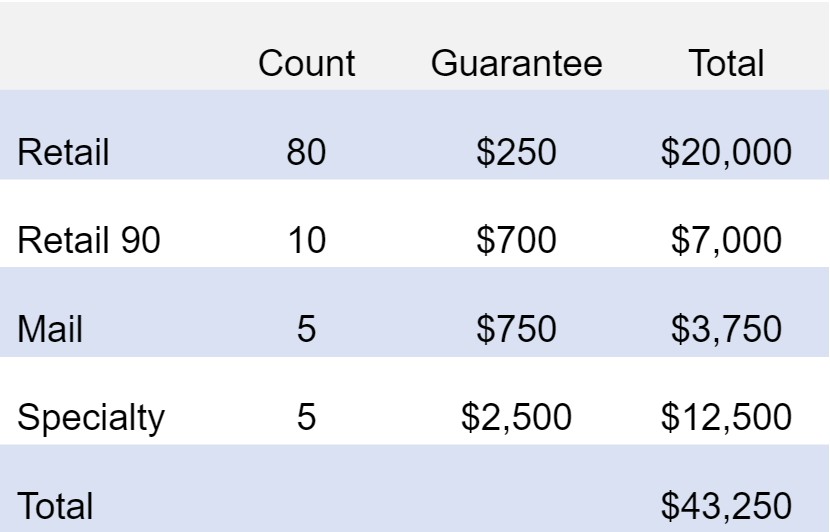
I addressed the pass-through contract in Part 1. When looking at channel-level guarantees a PBM will typically break down their guarantees into Retail Brand, Retail 90 Brand, Mail Brand, and Specialty Brand Rebate Guarantees. The simple math is to multiply the number of claims in each channel by the guarantees to get a projected rebate guarantee:
If it was really that easy, you wouldn’t be reading this article.
Rebate Calculus and Shell Games
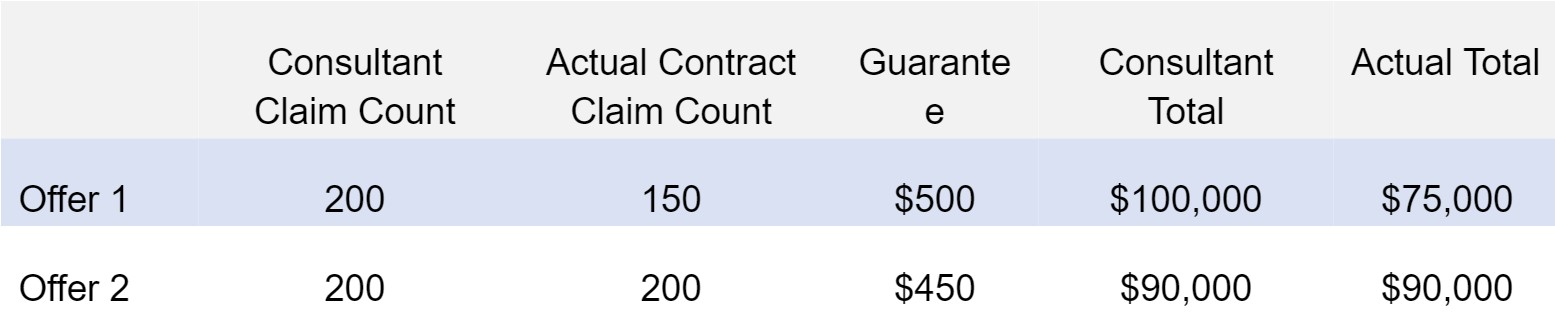
There are a lot of “games” inside of a pharmacy contract and consultants often have trouble combing through the weeds. The most important thing you can understand is that a PBM doesn’t win business if they have the best offer. They win business if you THINK they have the best offer. And while many people get mad at PBM’s over this – they didn’t contrive the industry as a grand master plan and its the inability of most consultants to properly compare them that forces them to play these shell games. I think of rebate manipulation as a division equation where the PBM’s strongest tactic is to manipulate the denominator. There is a total amount the PBM is willing to guarantee you in rebates – that is the numerator. Then there is the number of claims that are filled as the denominator. For the PBM to win, they need to have the highest quotient. Note, this is philosophically backward. You actually care about the Numerator. You are working backward from the quotient and denominator to arrive at the numerator. For example, if they were to offer $100,000 in rebates over 200 claims, that is $500 per claim in rebate guarantees. If someone else is willing to offer $90,000, that is $450 per claim. The $100,000/$500 per claim offer wins.
However, if a PBM knows the consultant is just taking all brand claims into account, and they can exclude a subset of 50 claims from their guarantees – the consultant will do the same math equation even though the PBM is only paying the rebate on 150 claims. Now, the PBM is offering a $500 guarantee over 150 claims for $75,000 in rebates but because the consultant is calculating it wrong and assuming it is over 200 claims the wrong PBM will win this RFP. See below as an example:
If you think this is annoying – imagine being the PBM salesperson for Offer 2. This is what makes accounting for as many rebate exclusions critical to doing an evaluation.
Common High-Impact Exclusions
Vaccines: Vaccines are excluded from virtually every rebate agreement. And let me tell you – covid really screwed up rebate projections because Vaccines typically process as brand claims. Many consultants multiplied their vaccine claims and included them as rebate-eligible claims. Big miss.
OTC: Over-the-counter medications like Pepcid, Nexium, Iron Pills, Prenatal Vitamins, etc. are often excluded from rebate contracts as well. However, there are some important caveats to this.
Diabetic OTC: Some claims for diabetes process as OTC claims but can be included in rebate guarantees. These include diabetic test strips and syringes and some older forms of insulin. This can be either included or excluded in a contract they can impact pricing significantly.
Limited Distribution Drugs: These are claims that the PBM has determined are from a limited subset of pharmacies and they may place a blanket exclusion. Again, the term varies wildly and can have a significant impact on pricing. You can find our article on this here:
The Bermuda Triangle of Exclusions: DAW 1 & 2, Formulary Exceptions and Multi-Source Brand exclusions are 3 ways to exclude a subset of similar drugs. DAW 1 & 2 claims are claims where either the patient or provider requested a brand medication over a generic. Think of filling Lipitor instead of atorvastatin. Multi-Source brands are a similar class of drugs, they are brands where there is another manufacturer of the medication (either a branded generic or generic medication). Finally, formulary exceptions are addressed both here and separately. Formulary exceptions are medications that are excluded from a PBM’s formulary but are approved because either the plan or a provider requested a formulary exception for medical necessity. Many times Multi-Source brands are excluded from a PBM’s formulary. Hence a PBM may say that they include DAW 1 & 2 claims, and they include Multi-Source brands – but ultimately they will avoid paying the claim because they are excluding a drug approved by formulary exception. Three different ways of targeting the same subset of drugs.
Formulary Exceptions 2.0: Formulary Exceptions are very difficult – because you cannot actually proactively calculate these exclusions, whereas it is entirely possible on the aforementioned exclusions. The reality is, that you do not know if a drug that is excluded will transition to a formulary drug or if a patient will be allowed to stay on their medication. This is particularly challenging in the specialty arena where patient biology is so nuanced it can’t be predicted whether or not a formulary drug will have the same effect. And providers will often request an exception due to continuity of care from a PBM. Here’s where it gets very complex – the PBM now has a massive incentive to APPROVE that provider request because they will NOT have to pay your client a rebate on the drug, even though they will certainly still receive one from the manufacturer. This is because they will receive a smaller rebate than had the patient used the preferred formulary medication.
HIV/Antiviral Claims: Some PBMs may exclude HIV or antiviral claims from rebate guarantees. This is high variability and high impact.
340B Claims: This is a near-universal exclusion. However, like Formulary Exceptions, it is not something you can proactively calculate. You do need to request a tight definition of what a 340B drug is as some PBMs have abused this language to classify all medications prescribed out of certain pharmacies as excluded – regardless of whether or not they were actually 340B claims.
PCSK9 Claims: These are claims such as Repatha and Praluent, also sometimes referred to as “Super Statins”.
Migraine Medications: These often refer to CGRP inhibitors such as Emgality, Aimoig, AJovy, and Nurtec (thanks Kardashians). These can vary by PBM and are less common but can have a significant impact because when they are excluded they are often found on a PBM’s specialty list.
Rebate Definitions
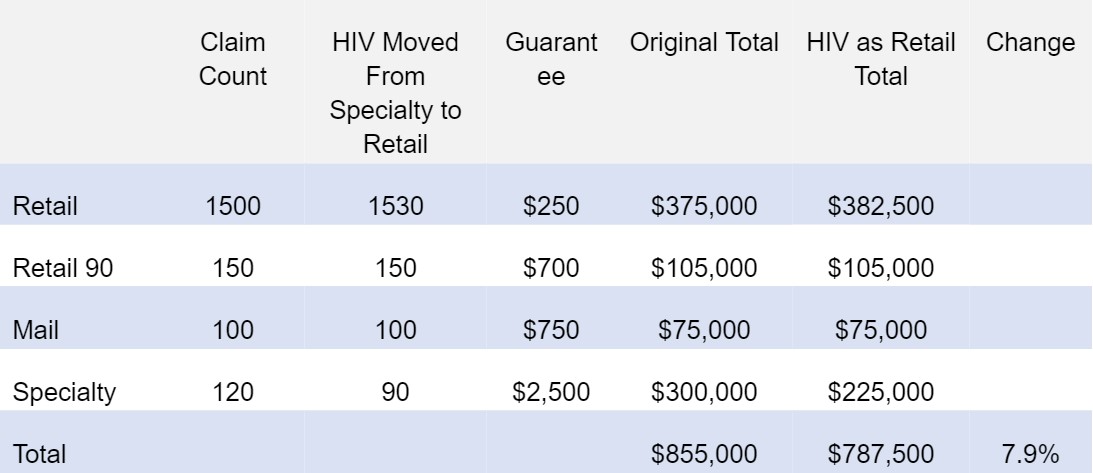
The second way that a rebate equation gets manipulated is by changing definitions. The two most common definition variances are in Limited Distribution Drugs and Specialty Drugs. Whether or not a PBM defines a drug as specialty is critical, as specialty rebate guarantees are often 10X of a retail guarantee. If a PBM can move drug A from specialty to retail, without you knowing it – they can win the spreadsheet game. Below is an example:
This is a very realistic example. 30 HIV claims could be just 2 or 3 HIV patients and can change the rebate projection by almost 8%. In some industries, HIV utilization is so high that it can move the needle 30%-40% in rebate projections just be how it is defined.
Rebate Statistics and Probability
We’ve moved from the concept of Rebate Algebra, to Rebate Calculus – but I want to encourage you to think of rebates more as a probability distribution. A clients utilization is going to change from year to year, and as discussed – there are some exclusions like formulary exceptions and 340B exclusions that you cannot really evaluate. The smaller the client – the more volatility you will see. One specialty patient can swing the rebates 15-20% for some smaller employers. You do not want to hang your hat on a specific rebate number with a client but help them understand that you are controlling for as many variables as is possible when developing your expected rebate projection for a given contract and that your relative comparison between PBM’s should be the main focus. The difference between PBM’s of your projected rebates should hold fairly constant with changing utilization and hence, should be the primary concern – less than the specific rebate number you are projecting.
If you are looking for a technology platform to help you create these projections in a matter of seconds not hours, to monitor your PBM’s performance and to scale it over your organization – that is exactly what we do at RingmasterRx and please feel free to direct message me on LinkedIn or contact us through our website at www.Ringmastertech.com.
Two fairly significant changes took place over the past 12 months that created a shift in how pharmacy contracts and formularies should be evaluated by consultants. The first was the reduction in insulin prices due to the American Rescue Plan Act of 2021. The second was the patent expiration for Humira and the launch of biosimilars onto PBM formularies. What binds these two changes is the fact that both the insulins impacted by the ARPA adjustments and the Humira claims had high list prices with high rebates attached. As PBMs adjust to the decrease in list prices and the decrease in rebates associated with them, they face a dilemma. PBMs have contractual guarantees set forth to meet particular per claim rebate guarantees in their contracts. As the rebates from these two classes of medications disappear – they will be unable to meet their contractual obligations. More challenging still, is that the PBMs are keenly aware that many consultants are evaluating their contracts based on guarantees and not giving any consideration to formulary adjustments. To solve this dilemma, the PBMs created “Rebate Credit Values”.
What is a Rebate Credit Value
A rebate credit value is a way for a PBM to capture formulary value for switching from a high cost, high rebate drug to a low cost, low rebate drug. It is financially accurate in evaluating net cost from a traditional repricing model. For example, a PBM may offer a $3,500 per specialty claim rebate guarantee. If that rebate guarantee allows for Rebate Credit Value – then the PBM will consider their financial obligation met if either of the following situations occur:
A claim that is ineligible for rebate credit values is filled and the PBM pays a $3,500 rebate payment to the client or;
A claim is filled that is not the originator product and the difference in the wholesale acquisition cost for the low-cost product vs. the originator brand product is $3,500.
Here’s a real life example. CVS prefers Hyrimoz over Humira. The WAC for a Humira claim is ~$6,645. The WAC for Hyrimoz claim is $1,248. The difference of $5,397 is considered a rebate credit value. The PBM will offset whatever contractual guarantee it has by $5,397 for every Hyrimoz claim that is filled.
What is Good About Rebate Credit Values
A rebate credit value is a creative way for a PBM to take credit for formulary value that they are creating without requiring as many complex calculations for the consulting community. In reality, if every PBM included rebate credit values in their methodology – we may actually have a more realistic estimation of the combined value of pricing and formulary.
What is Not Good About Rebate Credit Values
First, it’s not like PBM’s are proactively discussing this with all of their clients. Certainly these programs are disclosed to key partners but the onus for uncovering and accurately modeling these programs is largely left to the consulting community – which I dare say is largely ill-equipped to handle basic contract comparisons let alone complex ones.
Second, rebate credit values can work in a comparison only if all of the vendors are including rebate credit values in their contract. Many are unfamiliar with the practice, particularly the smaller – boutique PBM’s.
Finally, rebate credit values could create a distortion in client budgets. That’s because in most analyses the amount allocated to rebates will be inaccurately large while the drug cost projections will be overstated. Since we are giving formulary credit (drug cost impact) in a rebate column it will inaccurately overestimate a clients drug costs while also overstating a clients rebate projections.
What Should Consultants Do About Rebate Credit Values?
I am of the opinion that consultants should request all of their bids be with or without rebate credit values. Given that many PBM’s do not or cannot account for rebate credit values in their modeling – my personal preference is for all bids to be without rebate credit values.
One good thing to note is that we are starting to see even coalition contracts offer both a with and without – or wit or without for my Philadelphia friends.
In the interim – it’s imperative for budgeting purposes that consultants ask and know which of their contracts have rebate credit values so that they are accurately comparing offers when going to market.
In addition, not all rebate credit value programs are considered equal. While I’ve highlighted Humira and insulins like Novolog and Humalog, some PBM’s will push the envelope and include as many multi-source generics as possible – expanding into the world of Lantus, Advair and other multi-source products. This is all the more reason that the best practice for a consultant is to request all bids be without rebate credit values.
What If IHaveto Entertain a Bid With A Rebate Credit Value?
In some instances you may be facing a client who does not want to make a change and a PBM that will not offer a contract without rebate credit values. There are two different steps to consider:
Constrain the Rebate Credit Values: A consultant MUST have a specific list of drugs where rebate credit values will be offered. As mentioned earlier – a PBM may start to expand this list to the point where it can almost become a retention of all rebates because they are taking credit for generic utilization. This should be at a minimum constrained to insulins Novolog and/or Humalog and Humira.
Run a Standard Analysis: When you’ve constrained the PBM to the select medications you can run a normal comparison of rebates and drug costs.
Adjust to a Single Methodology: Once you’ve run your analysis you need to adjust all of the offers to a “with” RCV adjustment. For offers that were made without rebate credit values you should calculate the drug cost impact of their formulary. Ringmaster can provide a table that can assist you with this. If a PBM is preferring Yusimry, Hyrimoz, Adalimumab-Adaz, Amjevita or whichever alternative medication you should adjust your ingredient cost downwards to account for this shift. For PBM’s that are using a rebate credit value you should make the same ingredient cost shift downwards however and an offsetting decrease in the rebate calculation should be made as well.
What Does The Future Hold?
With the impending patent expiration of Stelara, the challenges presented to consulting firms on how to account for and manage rebate credit values will likely only be expanded. Collaborating with your PBM partners to understand how they are representing their rebate guarantees and what is included in them is going to be critical to managing your clients’ drug spend.
If the growth of biological medications was the earthquake, gene therapy would be the tsunami that does the real damage. Since Harvoni and Sovaldi started making their way onto plans in the early teens a wave of concern was ushered in around specialty medications. I recall presenting “1% of claims was 25% of spend and would be 50% within 3 years” back in 2015/2016 – and sure enough that all came to fruition. Now the new wave is upon in Gene Therapy. To date, there have been only about 10 Cell or Gene Therapy medications launched in the United States. By the end of 2024, that number will breach 50. The average price tag of a Gene Therapy launched in the US today is $2,000,000. It is imperative for consultants to start thinking about good practices for managing Gene Therapy and Cell Therapy. This article covers what Gene Therapy and Cell Therapy are, the major risks to plan sponsors in the pipeline, and some best practices for preparing your clients for the incoming onslaught.
What are Cell and Gene Therapies?
Gene Therapy and Cell Therapy are similar treatments. Gene Therapy uses DNA to manipulate a patient’s cells for the treatment of inherited or acquired diseases whereas Cell Therapy is the infusion of whole cells to accomplish this end. CAR-T is a type of cell therapy where T-cells are collected from the body and sent to a manufacturing site where chimeric antigen receptors (CARs) are added to T-cells. Hence, CAR-T. These innovative approaches to therapy solve a myriad of rare genetic diseases and cancers that previously had no therapeutic solutions.
Make no mistake, these cell and gene therapies are nothing short of miraculous. But with an average cost exceeding $2,000,000 – it’s imperative that consultants strategize about pre-emptive measures they can take to protect their clients.
What Cell and Gene Therapies are Available Today?
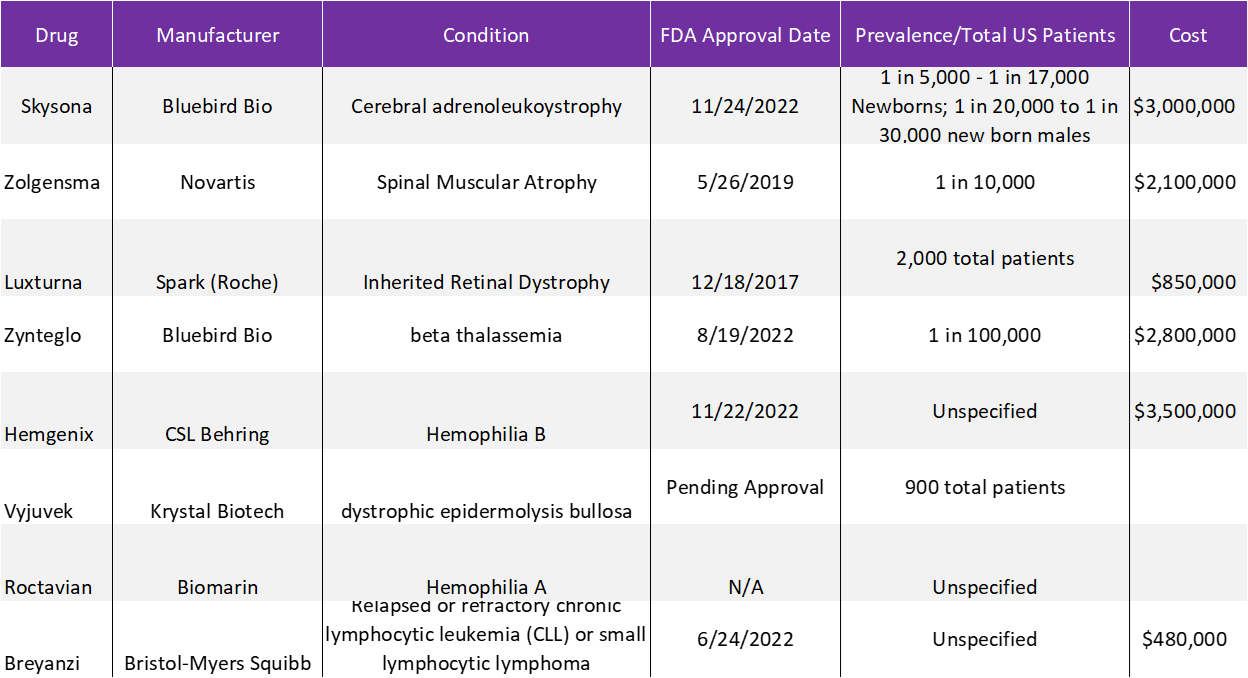
There are 27 FDA-approved Cell or Gene Therapies today. Here is a list of some of the most notable:
What’s the Concern For the Future?
McKinsey and Co. released a chart in September 2022 showing the potential growth of Gene Therapy and Cell Therapies by 2024 (see below). The rapid growth of therapies from 2021 to 2023 and 2024 is staggering. What’s more – there are over 300 Cell and Gene Therapies currently in development. While conditions such as inherited retinal dystrophy and beta thalassemia may seem exceedingly rare – it is the sum of all such rare diseases that should give consultants pause. There are over 7,000 rare “orphan” conditions in the United States impacting over 30 million patients. So the runway for Cell and Gene Therapies is long, the costs staggering and the probability uncomfortably high.
What’s My Risk?
The good news for most plan sponsors is that these treatments are typically one-and-done. A patient may receive treatment over the course of 30-90 days and in many instances will not need further treatment. This means no lasers on stop-loss policies or substantive risks to premiums. But there are two considerations we need to focus on:
Preventing an Uncovered Claim
Getting Value from the Treatment
Preventing Uncovered Claims:
Preventing uncovered claims in the Gene/Cell Therapy space is not all that different from a traditional setting. There are some things you can request that protect your plan:
Plan Mirroring
If a stop-loss has plan mirroring it just means that the Stop-Loss carrier agrees to cover whatever is in the plan document. If a claim is approved in accordance with the plan Summary Plan Description, there is no risk of an uncovered claim. Many times, a stop-loss policy can have exclusions that are listed separately in the policy which may not reflect the plan document. The most important in this context is the growing use of specific Gene Therapy and Cell Therapy exclusions. Consultants must keep a watchful eye on this approach. Tactically, a fly-by-night stop-loss carrier can offer much more competitive rates if they know they are not on the hook for the significant risks associated with this class.
No Lasering:
Lasers should not be much of a risk to a plan sponsor in the gene therapy and cell therapy space. That said, many Hemophilia A and B patients who are actively taking prophylaxis are going to be known risks to a stop-loss carrier. Should the patient join the plan mid-year before being scheduled for treatment for Hemgenix or Roctavian – it is a certainty they will be lasered for the upcoming year. No lasering provisions with max rate caps can be very valuable to employers as they move into the next few years. In fact, for employers with less than 500 employees, I believe No-Lasering provisions are almost a necessity given the uncertain risks.
Eligibility/Leave Management:
Coaching HR personnel at small to mid-size employers about properly handling FMLA and COBRA participants is perhaps one of the greatest risks in self-funding. A patient who should not be eligible for the plan due to the expiration of FMLA or COBRA that has been left on the plan and incurred a claim can easily turn into a coverage dispute. Making sure that HR personnel are keeping patients covered per their plan documents’ eligibility language is critical to avoiding this pitfall.
How Do I Ensure the Plan is Getting Value?
Addressing these high-cost therapies is going to require a paradigm shift in how plans consider coverage for high-cost medications. The FDA considers only efficacy and safety in its approval process. A recent JAMA article showed from 2017-2020 the FDA approved 206 new drugs of which 5 were not approved due to unfavorable benefit/risk assessments and 42 were not approved due to uncertainty of benefits or unacceptably high prices. Unfortunately, once a drug is FDA approved there are no pricing constraints on a manufacturer, unless there is a therapeutic substitute that PBM’s can use for negotiation purposes. It’s time for employers to start taking control over medications with excessive costs in their plan documents. This means building plan document language and coverage conditions that use independent evaluation of price as a determinant for coverage. A great resource for this is the Institute for Clinical and Economic Review (ICER). While some disagree with the methodology of ICER it is the only organization in the US that is an independent resource to assess cost/benefit analyses on high-cost medications.
Consider Hemophilia treatments recently launched and pending approval – Hemgenix and Roctavian respectively. In ICER’s Final Report, they found an evidence rating of B+ for Hemgenix vs. Factor prophylaxis and C++ for Roctavian again Factor Prophylaxis. This is mainly due to the fact that Roctavian’s impact has been shown to decline over time – meaning the benefits could be short-lived. In my opinion, until further research is available it would be advisable for a plan sponsor not to take such a significant risk to incur a multi-million dollar expense.
A strategy moving forward should be to incorporate ICER findings when available and not cover medications with less than a B or B+ rating. There are certainly shortcomings to this approach – mainly that ICER may not have a rating available for a medication as soon as it is released – or for years thereafter. A manufacturer may change the price of a medication to make it fit into the scope of ICER’s suggested ranges and adaptations should be made to address that. But it is clear to me that plan sponsors will need to take cost/benefit analysis into their own hands as the responsibility is not something the FDA takes into account.
Conclusion
In conclusion, the landscape of pharmacy benefits is rapidly evolving with the advent of gene and cell therapies, presenting both unprecedented opportunities and significant challenges for plan sponsors and consultants. The surge in gene therapy medications, with an average price tag exceeding $2,000,000, underscores the urgent need for proactive strategies to manage these innovative but high-cost treatments effectively. Consultants must guide their clients in understanding the risks posed by gene and cell therapies, including potential uncovered claims and the necessity of ensuring value from these treatments. Measures such as plan mirroring, no lasering provisions, and eligibility/leave management are crucial in mitigating risks and ensuring comprehensive coverage. Moreover, a paradigm shift towards independent evaluation of price and cost/benefit analysis, possibly leveraging resources like the Institute for Clinical and Economic Review (ICER), is essential for plan sponsors to navigate this complex landscape responsibly and sustainably. As the pharmacy industry braces for the impact of gene and cell therapies, informed decision-making and strategic planning will be paramount in safeguarding the financial health and well-being of plan sponsors and their beneficiaries.
The Employee Retirement and Income Security Act (ERISA) has always placed a burden on HR professionals and benefits committee’s to act as a fiduciary to their employees when designing the benefit plan and contracting with vendors. But a new lawsuit has placed a magnifying glass over this risk. A class action lawsuit filed against Johnson & Johnson on February 5th, 2024 has named The pension and benefits committee, the EVP and CHRO personally and the VP of HR personally as defendants in the suit. This development is likely the first of many lawsuits and it focuses on the pharmacy benefits management contract that was entered into by Johnson & Johnson.
What are the accusations?
The lawsuit alleges that the plan did not meet its fiduciary obligations to manage the plan in the best interest of the plan and its beneficiaries. Specifically, the lawsuit alleges that certain medications on the formulary were prohibitively expensive and well outside the realm of reasonable prices. The examples cited are teriflunomide, a generic form of Aubagio, for which the plaintiff was charged over $10,000 and can be found on some online pharmacies for as little as $30.00. The suit claims this result is a failure of the fiduciaries to meet their “duty of prudence”. The suit alleges that ERISA’s duty of prudence requires plan fiduciaries to make a diligent effort to compare alternative service providers in the marketplace, seek the lowest level of costs for the services to be provided, and continuously monitor plan expenses to ensure that they remain reasonable under the circumstances. While the example cited is very specific the suit alleges that it was likely the result of systemic failures of prudence in the PBM procurement process.
What Does This Mean For Employers?
For those responsible for the employee benefits plan, there is a growing threat of more class action lawsuits from plan beneficiaries. Many employers have failed to do their due diligence to evaluate pharmacy contracts. The end result of this lawsuit is more complex. While the suit focuses on specific medications with pricing abuse, a benefit plan is purchasing thousands of drugs from myriad pharmacies. Contracting for this broad basket of goods may mean procuring some drugs at uncompetitive costs while contracting competitively for the broad basket of goods. This conflict between the individual beneficiary and the beneficiaries of the plan as a whole is left undefined. Is the fiduciary obligation to the plan or to the beneficiaries? When an individual beneficiary may be harmed but the broader group of beneficiaries procures drugs at a lower cost – what is the proper decision? The J&J lawsuit will likely resolve this ambiguity.
With that being said, this conflict and ambiguity only arises in the event the plan sponsor followed a diligent and prudent procurement process for the broader basket of prescriptions. This is an addressable area for employers.
What Should HR Professionals Do To Protect Themselves?
While we cannot provide legal advice, the lawsuit itself – which can be found here – provides some suggestions as to what the standard of prudence that HR professionals must adhere to might look like in regards to their pharmacy benefits management plan. It first means going through a thorough and defensible process to evaluate vendors and ensure the existing contract is competitive with market rates. Working with your benefits consultant there are several keys to running a defensible procurement process:
Evaluating the pharmacy contract based on the actual claims data of the plan
Pharmacy contract offers can vary widely depending on the utilization of a plan and so a prudent plan sponsor should evaluate their contracts reflective of their actual utilization – this is specifically because one contract may price a drug very competitively (even at a loss) while it makes excessive profit on another.
Independently evaluating estimated costs
PBM’s are notorious for favorably interpreting their contracts. Plan sponsors should work with a consultant that has the ability to independently validate estimated costs based on the contract language. This means evaluating the Average Wholesale Price by drug channel and evaluating exclusions in the contract offer and the relative impact.
Making a conscious decision on Pass-Through Vs. Traditional Contract Types
Employer’s need to be aware of the differences and risks of pass-through vs. traditional contract and make a conscious choice as to the contract that best suits their plan.
Establish an ongoing Monitoring program.
Because utilization can vary within a pharmacy contract, both by drugs used and pharmacies used, employers should establish an ongoing monitoring practice to ensure that contract terms are being met and that excessive price gouging is not present in the plan.
Providing proper weight to programming and member experience
Within the formal RFP process employers should be sure to follow a documented process that considers and weighs PBM program offerings and service experience in conjunction with contract and pricing terms.
To date, the vast majority of pharmacy contracts are entered into haphazardly. Suggestions, recommendations, friends, ease, ideology and rhetoric are no substitute for a proper procurement process.
In summary, pharmacy contracting is complex, it requires a balance of art and science. Adhering to a documented and thorough process is the best defense for HR professionals. Many of these steps are specifically referenced in sections 38, 39, 55, 57, 62, 63, 85 on what a prudent fiduciary should do.
About 15 years ago my manager told me “I think this transparent PBM thing is gonna be a big deal”. What’s insane to think now is: He was absolutely right but I don’t think either of us really had any clue what we were talking about or why it would become a big deal.
Consultant knowledge of the pharmacy world has come a long way since the mid-aughts. It has grown leaps and bounds in the last 5-6 years. 6 years ago there were a handful of brokerage firms that had designated pharmacy consultants. Today, roughly half of firms have a designated pharmacy specialist in-house. But one persistent area of debate is on spread pricing vs. pass-through pricing models –which has evolved into near religious zealotry.
In this piece – I address how plan sponsors get billed, how pharmacies get reimbursed, spread pricing, pass-through pricing, and ultimately some best practices for deciphering which model is better for your clients.
What Determines How a Plan Sponsor is Billed For TheiSpreadr Drugs?
Ultimately, whether on a pass-through or spread contract, the main determinant for how a plan sponsor is going to be charged for their prescription drugs is their contract guarantees. Almost all pharmacy contracts are based on Average Wholesale Price, with an aggregate discount guaranteed on a basket of drugs such as “Retail 30”, “Retail 90”, “Mail Order” and “Specialty”. Average Wholesale Price is based on Medi-span, RedBook, or First Data Bank – three independent publishers who do have some variation in their reported prices. You may have over 1,000 different combinations of manufacturers and drugs representing 350+ unique drugs, with a wide variance in prices, filled under a single mid-size employer benefit plan. The PBM is going to give you a guarantee as a percentage off of those varying drugs AWP, for example, if the total AWP for all 150 generic drugs filled for a 30-day supply at a retail pharmacy is $1,000,000 – the contract may guarantee 85% off that $1MM for a total cost of $150,000 to the plan. The discount guarantee is always what is stipulated because the utilization can vary wildly from year to year based on enrollment changes and changes in people’s health conditions.
What Determines How a Pharmacy is Reimbursed for Dispensing A Drug?
A retail pharmacy negotiates a pharmacy network contract similar to that of an employer in order to be considered an “in-network” provider for a PBM. Many smaller retail pharmacies lack negotiating power and join “Pharmacy Services Administration Organizations” or PSAOs, to aggregate purchasing power and negotiate better reimbursements. It is critical to understand that pharmacies do not contract for a specific price for a specific drug – but use aggregate pricing similar to that of an employer. In the plan sponsor AWP example – the pharmacy may have a reimbursement of AWP – 90% or 91% for the same $1 MM in AWP – or $100k in reimbursements.
What is Spread Pricing?
The #1 way that a pharmacy benefit manager makes money is by buying low and selling high on prescription drugs. A PBM’s revenue is how much they charge a plan sponsor for prescription drugs as determined by their contract guarantees. The PBM’s costs of goods sold are how much they reimburse the pharmacy for a prescription. This is determined by their retail pharmacy network contracts. Their profit is the spread between the two numbers. In the example provided before – the revenue is $150k billed to the plan -the cost of goods sold is $100k paid to the pharmacy = $50k gross profit. The biggest benefit of pass-through pricing for the entire pharmacy value chain is that PBMs are highly motivated to drive down the profitability of retail pharmacies and lower their cost of goods sold – forcing them to be more efficient and lower prices. (Sidebar: I will say that this “benefit” has been taken to the extreme to the point where pharmacy revenues have eroded enough that communities are threatened with the loss of access to pharmacists – not unlike Wal-Mart driving local retailers out of business).
Up until the last 5 years – most consultants didn’t understand how PBM’s made money and never negotiated the price of the drugs for their plan sponsors. Those that did understand it: Some Health plans, TPA’s, and independent pharmacy consultants – captured the profit as resellers of the PBM’s service. This left plan sponsors paying costs that were sometimes 2x the market rate while the PBM, Consultant, or Health Plan (or a combination thereof) raked in massive profits or used it to subsidize lower administration fees to win business.
I’m happy to say that the advent of broker-owned consultants, high-integrity independent consultants, helped alleviate this pricing disparity and bring pricing more in line with the market. But another large contributing factor was the growth of an alternative form of PBM contract:
What is Pass-Through Pricing?
Pass-through pricing is a cost-plus form of PBM contract. The PBM charges the client the exact amount that the pharmacy is reimbursed and then charges an administration fee for processing. This fee can be anywhere from $2.50 up to $12.00 per claim or higher. The benefit, theoretically, is the client is getting the same acquisition cost for the drug as the PBM and so the cost of the drug should be much lower than the marked-up spread pricing cost of the drug.
What are the Benefits of Pass-Through Pricing?
Pass-through pricing is very effective at constraining pricing abuses by a PBM. When a plan has very good utilization (lots of low-cost generic drugs), a PBM with a spread contract benefits from that utilization. The plan sponsor could have a drug mix that is costing the PBM AWP – 95% ($50,000 in the previous example) – and this creates the opportunity for the PBM to continue billing the client the $150k and increase profitability dramatically. In order to accomplish this, the PBM may target pockets of drugs and dramatically increase the billing amount to the plan sponsor to maximize profitability. The client has limited to no “upside” in a spread contract whereas the client wins if its drug mix is favorable on a good pass-through contract.
Pass-through pricing was and is, a very well-intentioned response to a market with unbridled greed and abuses that takes place. But then it got hi-jacked:
Down the Rabbit Hole, We Go
If you follow the basic math of spread pricing it’s A + S = C. Acquisition cost + Spread = Client Cost. If you follow the basic math of pass-through pricing it’s A + F = C. Acquisition Cost + Fee = Client Cost. I want to emphasize something here. The number a consultant cares about is C. That’s it. Everything else is superfluous. But what the focus started to become was on the spread – “S”. “S” is NEVER a known variable. And that is incredibly frustrating – you will never know how much a PBM really makes on a spread contract. “F” is always known. It is an immutable number – not a variable. And the assumption became – “If I know “F” and I don’t know “S” – then my “C” will be better because I know “F”.
But let’s turn our attention to acquisition cost. There is an assumption in this calculation that acquisition cost is the same across PBMs. And it absolutely is not. It varies wildly. And if you parallel this to a grocery store – you know Wal-Mart’s purchasing power gives them a better acquisition cost than your local grocery store. But you also know that doesn’t necessarily mean that Wal-Mart is going to offer you a better price on some items than your local grocery store. Yes, the bigger the PBM, it’s likely the better the acquisition cost. But that doesn’t mean you are getting the best price because of that darn variable “S”.
Unfortunately, as the focus became more so on “Spread” vs. “Fee” the focus on “C”, Client Cost, was lost. Some PBMs started to figure out that they could say they offer a “Pass-Through” contract as an effective sales pitch, or misdirection, to try to incite plan sponsors’ anger at their PBM. But more importantly – by focusing the conversation on the Fee and not the acquisition cost or client cost – the PBM figured out it could make MORE money on its spread contracts (exacerbating the abuse) by convincing some clients to go on pass-through contracts. This is where the math gets very complicated and there is something extremely important to remind you about how PBM’s reimburse pharmacies:
A PBM can change what it pays a pharmacy for a prescription ALL THE TIME. Their contracts with pharmacy chains are in aggregate, just like their contract with employers.
For simple math: This means that if a PBM is obligated to pay a pharmacy $4.00 for a lisinopril claim on average – it could reimburse the pharmacy $2.00 one day and reimburse the pharmacy $6.00 the next day. The average reimbursement of $4.00 is achieved.
If a PBM has a pass-through contract with “Employer A” and a spread contract with “Employer B” – they can increase their profit margin on Employer B by driving up the cost of Employer A. See the example below:
But if “Employer A” has negotiated its contract and focused on “C” – their cost would still be potentially higher in this example than “Employer B”, but the PBM won’t have the opportunity to increase its profits.
This brings us to one final consideration: MAC lists. A MAC (Maximum Allowable Charge) list is a schedule of charges for each drug class. With up to a dozen different manufacturers of a particular drug, a PBM will set a list of charges to the plan regardless of which manufacturer made the drug. A PBM can have multiple Mac lists, each representing a different profitability depending on a client’s utilization. They also have the ability to “factor” these lists up or down in price. Some PBMs have dozens of MAC lists. Others have a single MAC list – or, if their pricing is based on NADAC (National Average Drug Acquisition Cost) that is equivalent to having a single MAC list. To get the “upside” of drug utilization your PBM has to have a single MAC list or use NADAC. Otherwise, the PBM can still manipulate the plan sponsor’s pricing.
Here are the key takeaways I hope you take from this:
If A PBM Offers both Spread and Pass-Through – lean towards the Spread: It is a paradox that while the PBM is going to make more money on your contract because of the spread – they will be doing so at the expense of their pass-through clients.
If A PBM Offers Pass–Through, You Need to Know Your MAC List: If the PBM has multiple MAC lists – there is a limitation to the amount of upside you may see on your contract. If a PBM will share their MAC list with you – you’re in. I lean towards the concept that NADAC is the most effective cost basis and I believe we may see a shift towards it in the industry for Pass-Through PBM – the PBM has essentially relinquished its control of its MAC lists in this situation (at least for drugs that have a NADAC price).
All Things Being Equal – Pass-Through is Better: The profit still came from the spread contract – not the pass-through contract. If your sole focus is on controlling PBM profitability, pass-through accomplishes this. You also get the upside on a pass-through contract of improvements in acquisition cost. You are unlikely to get much if any upside on a spread contract. But you need to address with the PBM the other contracts that they offer in the market and their use of MAC lists in order to identify if you’re on a “high quality” pass-through contract. Also – “All Things Being Equal” is the critical caveat. Don’t ever lose sight of Client Cost in the contract – a pass-through contract still needs to have strong contract language that is competitive with other offers.
If Your Client Owns the Pharmacy –You HAVE to be on Pass-Through: Grocery store chains, pharmacies, hospitals, or physician practices with in-house pharmacies or tribal entities with tribal-owned pharmacies should all have Pass-Through contracts. This is because the spread mechanism acts like a sieve draining money out of the organization by charging the health plan a high amount and reimbursing the pharmacy a low amount. In this situation, the only thing we care about is limiting the PBM’s profitability – which as mentioned is best done by a Pass-Through contract.
Conclusion
In conclusion, the debate between spread pricing and pass-through pricing models in pharmacy benefit management (PBM) contracts has evolved into a complex discussion with significant implications for plan sponsors and pharmacies alike. While spread pricing historically allowed PBMs to generate substantial profits by leveraging pricing differentials between plan sponsors and pharmacies, pass-through pricing emerged as a response to promote transparency and constrain potential abuses. However, the narrative surrounding these models has become increasingly nuanced, with PBMs sometimes leveraging the focus on fees in pass-through contracts to maximize profits on spread contracts. Understanding the dynamics of acquisition costs, maximum allowable charge (MAC) lists and contract guarantees is essential for consultants and plan sponsors to navigate this landscape effectively. Ultimately, the key takeaway is to prioritize client cost (C) and ensure that contract structures align with the best interests of the plan sponsor, whether it be through well-negotiated spread contracts or high-quality pass-through arrangements. Each scenario demands careful consideration and a strategic approach tailored to the specific needs and goals of the client.
Most people think of the term “generic drugs” as a universally accepted group of drugs. Obviously, it’s just a drug sold under its chemical name. But in a pharmacy contract – the umbrella term “Generic” has myriad ways that PBMs can reclassify medications and charge clients more for prescriptions. In particular, the most abused classification of generic drugs may be those that are defined as specialty medications by a PBM. This may be a bit hard for some people to understand because it requires some foundational knowledge of the pharmacy benefits management landscape: Spread Pricing, Contract Guarantees, and Specialty Lists. Below I will highlight a very cursory overview of these items and how they combine to create significant volatility in drug pricing on specialty generics.
What is Spread Pricing
The topic of spread pricing could be a book in and of itself and, fortunately, is something many consultants are now familiar with. It is greatly vilified, and greatly misunderstood. Its foundation is built on the great misconception that there is a “Price” for a drug. The price that a plan sponsor pays for a medication is the price which is charged by the PBM to the plan sponsor. The PBM then reimburses the pharmacy that dispensed the medication a completely different amount. The PBM’s profit is the difference between the two numbers. And there is really no requirement the two numbers need to be related. Even in accounting for PBMs – the amount a plan sponsor pays for the drug is considered “Revenue”, and the amount reimbursed to the pharmacy is considered “Cost of Goods Sold”. That practice is the core of spread pricing. While the price is generally based on a combination of the manufacturer of the drug, the drug itself, and the pharmacy dispensing it, it is imperative to understand that it does not have to be based on anything. The PBM can charge a client in a completely arbitrary manner for a prescription drug at any given time. This practice is akin to how you buy groceries at a grocery store. You have no clue what the grocery store bought the item for – you only know how much the grocery store is charging you for the item. The amount the grocery store makes in profit on each item can vary greatly from item to item. In the PBM world – you do not know how much the PBM is actually reimbursing the pharmacy for the medication – you only know how much they are charging your client. The alternative to spread pricing is pass-through pricing – which I’ll emphasize is no panacea. This is a cost-plus method. In the grocery store analogy – you would know how much profit the grocery store is making – and you know how much you are being charged. But you have no idea how good their acquisition cost is and absent a market reference point – you still have no idea how competitive the price for that item is. So the logical question should be: what should an employer do to make sure the price they’re paying for a drug is reasonable?
How Do Contract Guarantees Work
Using the above examples – a consultant and their client can put guardrails around how much a spread PBM contract (or pass-through contract) can charge by working to get a client-level contract guarantee that limits the pricing manipulation over the course of a year. It also ensures that pass-through PBM contracts have a competitive acquisition cost for the drugs rather than just passing through a high-cost drug with an additional markup. Grocery Store analogy – if I bought an item from CVS and added $3.00 – I might be making less than Wal-Mart on the item but the purchaser would certainly be paying more than if they bought the item from Wal-Mart. These guarantees typically work with an “AWP – %” approach that takes a published Average Wholesale Price, typically from First Data Bank, Medispan, or Redbook, and provides an overall guaranteed discount percentage. A growing alternative pioneered by PBMs, such as CapitalRx, are NADAC plus models. NADAC stands for the National Average Drug Acquisition Cost. These pricing methods use the acquisition cost of a pharmacy, as reported to CMS by pharmacies, and add a dispensing fee or transaction fee. Regardless of the model, these guarantees are typically structured into channel guarantees such as “Retail 30 generic”, “retail 30 brand” or “specialty”. And it’s that last category where some of the most egregious abuses take place.
What are Specialty Lists and Why Should I Care?
We talk A LOT about specialty drugs in the PBM industry. But have you ever asked the question: what exactly is a specialty drug? Funny you should ask….because it depends. CMS defines a specialty medication as any drug over $600.00. Which is a lot of drugs at this point and a very arbitrary definition. In practice, the definition of a “Specialty” drug depends entirely on the PBM’s independent definition. And the PBM’s definition is also arbitrary. (The frequency with which I use the word arbitrary in the PBM space should be indicative of some of the overall issues plaguing the industry). Every PBM maintains a “Specialty Drug List” and the drugs on it can vary wildly. In some instances migraine medications like Emgality are on the list – in others, they are not. In some instances, HIV medications are defined as specialty – and in others, they are not. So when you are reviewing two PBM contracts that have a contract guarantee for specialty drugs at 20% and a specialty rebate of $2,800 – the actual result of that contract can have a substantial variance depending on what exactly the PBM defines as a specialty drug.
Where Are My Clients at Greatest Risk?
The largest percentage markups I see in the pharmacy industry are on drugs that are generic drugs that are defined as Specialty. Again, the definition is arbitrary, so drugs that have a NADAC of $6.00 can be billed to plan sponsors at rates 10X – 20X that amount or more. Drugs like Methotrexate, Mycophenolate, and Tacrolimus often find themselves on these lists despite having been around for decades and being simple chemical compounds (non-biologic medications) that require no special handling. Perhaps the single greatest abused drug in the industry is Imatinib Mesylate – the generic form of cancer medication Gleevec. I have used this example countless times. This drug has a NADAC of ~$250 for a 30-day supply but may be billed to plans at $5k-$8k per month. You can buy this drug at Costco for $250. You can see a great example illustration of this on the Ohio Medicaid plan in 2018 done by 46brooklyn (which is a website consultants should familiarize themselves with). The illustration shows the average markup of various drugs in the space. While this analysis was done in 2018 it’s a practice I still see today. As more and more biologic brand specialty medications fall off patent – it is highly likely that they will find themselves under this classification of medication. That is what is happening with drugs like Gleevec vs. imatinib mesylate, Zytiga and abiraterone acetate, Tecfidera, and dimethyl fumarate and it is almost certainly going to happen with generic forms of Humira. The list goes on and on.
What Can I Do To Protect My Clients From This Practice?
There are three steps that a consultant can take to help manage this practice. The first and easiest step is to ask for a specialty generic guarantee in your contract. Specialty guarantees often have an overall effective guarantee of 19%-22% depending on the contract. This is not a very good discount on a generic drug with multiple manufacturers. Asking for a specialty brand and specialty generic discount will lower your specialty brand discount guarantee but you should see a 55%-70% discount on specialty generic medications. This alone will greatly reduce the volatility of your clients’ performance and reduce the opportunity for abuse.
The second step a consultant should take is doing apples-to-apples comparisons. It is imperative you request a specialty drug list from a PBM when asking for a bid so you can do an apples-to-apples comparison. If you are not comparing specialty definitions you are doing your client a disservice.
The third step is to look for the above-mentioned drugs and see if the generics are on the formulary. Some PBM formularies will exclude the generic versions of these specialty medications and drive the brand medication so that higher drug rebates can be achieved. This may lead to a lower net cost for the client – but it needs to be reflected in substantially higher rebate guarantees and you should consider adjusting your analysis to account for higher drug prices on the PBM using this practice.
Finally, you can look for NADAC-based contracts. NADAC is not a panacea – you still need to do the work and evaluate the net cost to a client. But if I were to define where, in my opinion, NADAC-based contracts are the most effective – it is in eliminating this contract gamesmanship of specialty generic definitions. With the drug cost based on an independently reported (and more accurately reflected market rate) the opportunity for specialty generic manipulation is almost completely eliminated. Only when a drug does not have a NADAC price would the client be open to manipulation – which is rare in the generic drug market.
Conclusion
In conclusion, understanding the complexities and potential pitfalls of pharmacy benefit management (PBM) contracts, especially concerning specialty medications and generic drugs, is crucial for consultants and their clients. The practice of reclassifying generic drugs as specialty medications by PBMs can lead to significant cost discrepancies and potential exploitation of clients. By grasping concepts like spread pricing, contract guarantees, and specialty drug lists, consultants can navigate these challenges more effectively. Implementing strategies such as securing specialty generic guarantees, conducting thorough comparisons, examining formularies for drug exclusions, and exploring NADAC-based contracts can help mitigate risks and protect clients from overpriced medications. With diligence and strategic planning, consultants can play a vital role in safeguarding their clients’ interests and promoting transparency and fairness in pharmaceutical pricing practices.